
True Catalyst Nitro Pro Goalie Pads — Full Review
The True Catalyst Nitro Pro is True’s 2026 flagship goalie leg pad, built by the same Lefevre craftsmen behind the PX3 and PX5 before it. It’s already been adopted by 12+ NHL goalies — Juuse Saros, Jordan Binnington, John Gibson, Anthony Stolarz, and Joey Daccord among them — making it one of the fastest pro adoptions of any pad in the 2025-26 season.
The Nitro Pro replaces the PX5 in True’s Catalyst lineup. Same Lefevre DNA, same handcrafted construction, but with three meaningful upgrades: new SCF foam for lighter weight and harder rebounds, a patented Post Connection System (PCS) toe bridge for better RVH integration, and an adjustable-stiffness knee stack that lets you dial in flex without swapping pads.
Here’s everything you need to know.
Quick Specs
| Spec | Detail |
|---|---|
| Line | True Catalyst (Lefevre) |
| Release | 2026 (first NHL sighting: September 2025) |
| Pad profile | Stiff, structured butterfly |
| Core foam | SCF (new for Nitro Pro) |
| Thigh rise | Composite-reinforced, thinner than PX5 |
| Knee stack | Adjustable stiffness via integrated strap |
| Knee rolls | Flat (flatter than PX5) |
| Toe bridge | PCS (Post Connection System) — patented |
| Calf system | FRS (Fast Rotation System) — double internal adjustable straps |
| Sr sizes | 32+2″, 33+2″, 34+2″, 34+1.5″ |
| Weight | Not officially published; lighter than PX5 per early reports |
| MSRP | $2,099.99 USD (pads only) / $3,329.97 (full custom set) |
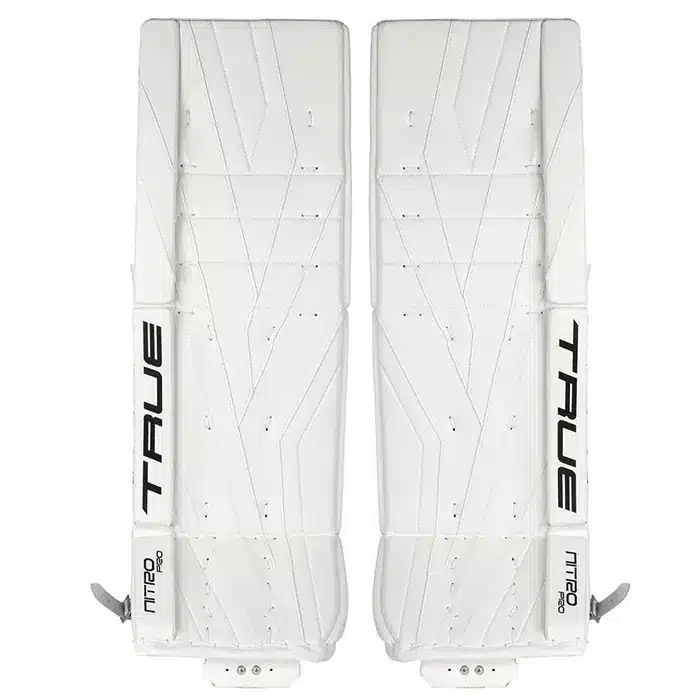
SCF Foam — Lighter Pads, Harder Rebounds
The biggest material change from the PX5 is the SCF foam core. True replaced the PX5’s internal foam with SCF, a lighter material that generates more rebound energy per impact. The result is a pad that weighs less (True hasn’t published an official spec, but hands-on reports consistently describe the Nitro Pro as noticeably lighter than the PX5) and pushes pucks further.
This isn’t a subtle difference. The rebound response is crisper and more directional. Pucks come off the pad face hard and go where the pad face sends them — typically to the corners, away from danger. If you’ve used the PX5, the Nitro Pro feels like the same pad with the volume turned up on rebounds.
The trade-off question is durability. SCF foam is new. There’s no multi-season consumer data on how it holds up over 60+ games. The pro adoption rate suggests True is confident — you don’t put unproven foam into the pads of a dozen NHL starters — but it’s worth noting as the honest answer until the material has more time on consumer ice.
Post Connection System (PCS) — RVH, Solved
The PCS toe bridge is the feature True is leading with, and it’s the most visually obvious change from the PX5.
It’s a patented, oversized toe bridge designed specifically for Reverse VH. The shape is engineered to grab the post and lock the pad in place. When you push into the post, the PCS transfers energy more efficiently than a traditional toe bridge — you get a stronger push-off and a more stable seal without fighting the pad to stay in position.
Forum users on The Goal Net have described the PCS as “gigantic,” and they’re not wrong. It’s significantly larger than the PX5 toe bridge. The binding design around it also changed to improve how the pad integrates with the post — the system is built so that when you drop into RVH, the pad finds the post naturally.
If you spend significant time in VH/RVH, the PCS is a meaningful upgrade. The connection is tighter and more consistent than anything else on the market at this price point.
If you rarely play post, the PCS is still a functional toe bridge — it just looks bigger than what you’re used to. It won’t hurt your game, but it won’t be the reason you buy these pads either.
Adjustable Knee Stack
On the PX5, knee stiffness was fixed. You got what you got, and if it didn’t match your preference, your options were to break the pad in differently or live with it.
The Nitro Pro fixes this with a simple integrated strap. Tighten it for a stiffer, more locked-in feel — useful for goalies who want the knee stack to hold firm in the butterfly and provide a solid push platform. Loosen it for more flex and mobility — better for goalies who want quicker transitions and a more responsive feel through the knee.
It’s not a complicated mechanism. It’s a strap. But it solves a real problem: different goalies want different knee feel, and now you can adjust it instead of hoping the pad breaks in the way you want.
Flat Knee Rolls — A Deliberate Change
The Nitro Pro’s knee rolls are flatter than the PX5’s. This isn’t an accident or a cost-saving measure — it’s a design choice aimed at more predictable, harder rebounds off the knee area.
Flat knee rolls create a more uniform surface for the puck to contact. There’s less curvature redirecting pucks unpredictably. The rebounds come off harder and more consistently in the direction the pad face is pointing.
Some goalies on The Goal Net forums have noted this shift. One user commented on True “getting rid of knee rolls on what’s supposed to be their more traditional line.” It’s a fair observation. If you specifically loved the PX5 for its pronounced knee rolls and the rebound character they created, the Nitro Pro will feel different in this area. The stitch lines are still there, but the actual roll profile is reduced.
The trade-off is worth it for most goalies — harder, more predictable rebounds outweigh the aesthetic and feel of traditional rolls — but it’s an honest difference to be aware of before buying.
Construction & Build Quality
These are still handcrafted Lefevre pads. The Catalyst line uses a composite core in the thigh rise that accomplishes two things: it keeps the pad rigid and structured (important for consistent five-hole seal), and it makes the thigh rise itself thinner than competing pads.
Thinner thigh rise means easier overlap at the top of the butterfly. Your pads close the five-hole faster without fighting extra material. The PX5 already had a composite-reinforced thigh rise that was 30% stiffer and 40% thinner than the PX3 — the Nitro Pro continues that direction.
The Fast Rotation System on the calf uses double internal adjustable straps. You can tune how the pad rotates and how weight distributes across your lower leg. Combined with the adjustable knee stack, you have more built-in fit customization than most competitors offer without aftermarket modifications.
Standard True strapping throughout — elastic and velcro systems. Hybrid Pro Lace toe ties are available as an option.
NHL Goalies Using the Catalyst Nitro Pro
Per GearGeek, 12 NHL goalies currently wear the Catalyst Nitro Pro pads:
| Goalie | Team |
|---|---|
| Juuse Saros | Nashville Predators |
| John Gibson | Detroit Red Wings |
| Jordan Binnington | St. Louis Blues |
| Anthony Stolarz | Toronto Maple Leafs |
| Joey Daccord | Seattle Kraken |
| Philipp Grubauer | Seattle Kraken |
| Joel Hofer | St. Louis Blues |
| Samuel Ersson | Philadelphia Flyers |
| Joonas Korpisalo | Boston Bruins |
| Jonas Johansson | Tampa Bay Lightning |
| Casey DeSmith | Dallas Stars |
Joey Daccord was the first goalie spotted wearing the Nitro Pro at the Seattle Kraken’s training camp in September 2025. Within months, a dozen starters had switched. For context, the PX5 was already the most-used pro pad by many counts on GearGeek — the Nitro Pro is picking up right where it left off.
That level of pro adoption this quickly says something. These aren’t paid endorsements driving the numbers — True/Lefevre has built trust with pro goalies over years, and the Nitro Pro is the latest expression of that relationship.
On-Ice Performance
Rebounds: Hard and directional. The flat face and SCF foam combine to push pucks out of the crease consistently. You’re not getting soft, absorbing rebounds that die in front of you. The pad fires pucks to the corners. If you’re a goalie who wants rebounds to stay close for control, this pad works against that instinct by design.
Sliding: Smooth. The Catalyst line has always performed well on lateral movements, and the FRS calf system keeps the pad tracking cleanly during pushes and recoveries. New face materials contribute to the slide, though True hasn’t published a specific technology name for the sliding surface (unlike Bauer’s S.L.1.D.3.R. or Brian’s Primo Slide).
Butterfly seal: Excellent. The composite thigh rise and thin profile close fast. The adjustable knee stack means you can find the sweet spot between stability (for holding the butterfly) and flex (for quick transitions). The seal at the five-hole is as good as anything on the market.
RVH: The PCS toe bridge delivers. The pad seals to the post quickly and stays put. The push-off is strong and stable. Whether the slightly unusual look and size of the toe bridge matters to you is a personal call, but the function is there and it’s the best RVH integration we’ve seen in a retail pad.
Recovery: Good but not the fastest on the market. The Nitro Pro is a stiffer, more structured pad than the Bauer Vapor FlyLite or CCM EFlex 7. You sacrifice some of that instant snap-back mobility for precision and consistency. It’s a deliberate trade-off, not a flaw.
Sizing & Availability
Senior sizes: 32+2″, 33+2″, 34+2″ (some retailers carry 34+1.5″)
The Nitro Pro is available two ways:
Stock/graphic colorways ship faster and typically run $2,099.99 USD per pair. Available at Sports Etc, Majer Hockey, and other select retailers. Stock means you get the default True graphic in white or a limited set of colorways.
Full custom also runs $2,099.99 USD per pair through Goalie Monkey, or $3,329.97 for a full set (pads + glove + blocker) through Pure Goalie’s customizer. True’s online customizer at customizer.truetempergoalie.com lets you design your colorway zone by zone, choose specs, and order through authorized retailers.
In Canada, stock colorways run approximately C$2,499.99.
Custom orders have lead times — expect several weeks for delivery. Stock colorways ship faster when in stock.
Note: There is also a Catalyst L87 Nitro Pro variant available through Goalie Monkey. The L87 is True’s alternative pad shape (different from the standard Catalyst profile). If you’ve used L87-pattern pads before, the Nitro Pro is available in that configuration too.
Durability
True/Lefevre pads have a strong track record for durability at the NHL level. The composite thigh rise holds its structure across seasons, and the synthetic outer materials resist wear. These pads are built to take punishment.
The SCF foam is the unknown variable. It’s new for 2026, so there’s no long-season consumer data on how it holds up over 100+ hours of ice time. The pro adoption rate is encouraging — True wouldn’t put untested foam into a dozen NHL goalies’ setups — but we’re being honest that multi-year durability is unproven at this point.
No specific warranty information has been published for the Nitro Pro line. True’s standard goalie equipment warranty applies — check with your retailer for current terms.
Price Comparison
| Pad | MSRP (USD) | Style |
|---|---|---|
| True Catalyst Nitro Pro | $2,099.99 | Stiff butterfly |
| True Catalyst PX5 | $2,099.99 | Stiff butterfly |
| Bauer Vapor FlyLite | ~$1,599.99 | Mobile butterfly |
| CCM EFlex 7 | ~$1,499.99 | Hybrid/classic |
| Brian’s Optik 4 | ~$1,599.99 | Stiff butterfly |
| CCM Axis XF | ~$1,499.99 | Power butterfly |
| Bauer Supreme Shadow | ~$1,499.99 | Stiff butterfly |
The Nitro Pro sits at the top of the market on price. You’re paying a premium for handcrafted Lefevre construction and True’s newest technology. The only retail pads in the same price range are the PX5 (which the Nitro Pro replaces) and custom options from other brands.
Whether that premium is justified depends on your level of play. For competitive goalies at college, junior, or pro levels, it’s a reasonable investment. For recreational beer league, you’d get excellent performance from pads at half the price.
Verdict
The True Catalyst Nitro Pro is the best Catalyst pad True has made. The SCF foam, PCS toe bridge, and adjustable knee stack are genuine improvements over the PX5 — not marketing refreshes.
It’s built for goalies who want a stiff, structured butterfly pad with hard directional rebounds and excellent RVH integration. If that’s your style, there’s nothing on the market that does it better right now. The pro adoption numbers back that up.
The honest downsides: it’s expensive ($2,099.99), the SCF foam is unproven long-term, and the flat knee rolls are a departure from the PX5 that not every goalie will prefer. If you want a softer, more flexible pad, look at the CCM EFlex 7 or Bauer Vapor FlyLite instead.
But if you want what 12 NHL starters are wearing — and you want the precision and control that Lefevre pads have delivered for decades — the Nitro Pro is the one.
Where to Buy
- Check Pure Goalie Price — Full custom design available
- Check Goalie Monkey Price — Custom and L87 Nitro Pro variant available
We appreciate your support! At no extra cost to you, we may earn a small commission if you purchase a product through GoalieCoaches.com.